Luc Brunet – 3 July 2025
We have just emerged from a tumultuous period, now referred to as the 12-Day War between Iran and Israel. As with all significant geopolitical crises, there are numerous lessons to draw—not only from the brief yet intense conflict itself, but also from the preceding build-up and subsequent fallout.
Identifying these lessons, however, is no simple task. The extraordinary volume of noise—propaganda, disinformation, and emotionally charged rhetoric—flooding both mainstream media and social networks complicates any effort to reach clear conclusions. Contributing to the confusion also is the communication style of the U.S. President, whose erratic messaging often muddles (and irritates) rather than clarifies.
Yet, despite the complexity, it is crucial to attempt a structured reflection. Below are several lessons that merit serious consideration.
Lesson 1: The Declining Credibility of Western Diplomacy
The Minsk agreements, brokered in 2015 and later admitted by Angela Merkel and François Hollande to have served as a cover for Ukraine to prepare for military confrontation with Russia, were a watershed moment in the erosion of Western diplomatic credibility. Regardless of one’s perspective on that conflict, the admission revealed a fundamental breach of trust.
A similar pattern emerged during the recent Iran-Israel confrontation. While nuclear negotiations between Iran and the U.S. were still ongoing, Israel launched a series of aggressive actions, including the assassination of members of Iran’s negotiation team. Such actions violate the basic norms of diplomacy, where protection of diplomatic interlocutors is sacrosanct.
If diplomacy becomes a tool of deception rather than resolution, trust in any Western-led negotiations will continue to erode. Iran, like Russia and China, may need to reassess its strategic assumptions and place greater emphasis on self-reliance in economic, technological, and military spheres.

Lesson 2: North Korea was right
Iran, by all available evidence, abided by international agreements regarding its nuclear program and refrained from developing a bomb. And yet, it was bombed and punished nonetheless.
In contrast, North Korea—armed, belligerent, and openly defiant—faces no comparable consequences. The reason is simple: deterrence works. North Korea’s nuclear capability has ensured its survival, not international treaties or goodwill.
Israel, meanwhile, maintains a substantial nuclear arsenal without having signed the Non-Proliferation Treaty (NPT) and continues to act with impunity.
Given this imbalance, Iran’s recent decision to curtail cooperation with the IAEA and the potential withdrawal from the NPT may be viewed not as provocation, but as self-preservation. A nuclear test, while controversial, could serve as Tehran’s ultimate insurance policy.
Lesson 3: Western technology is to be feared
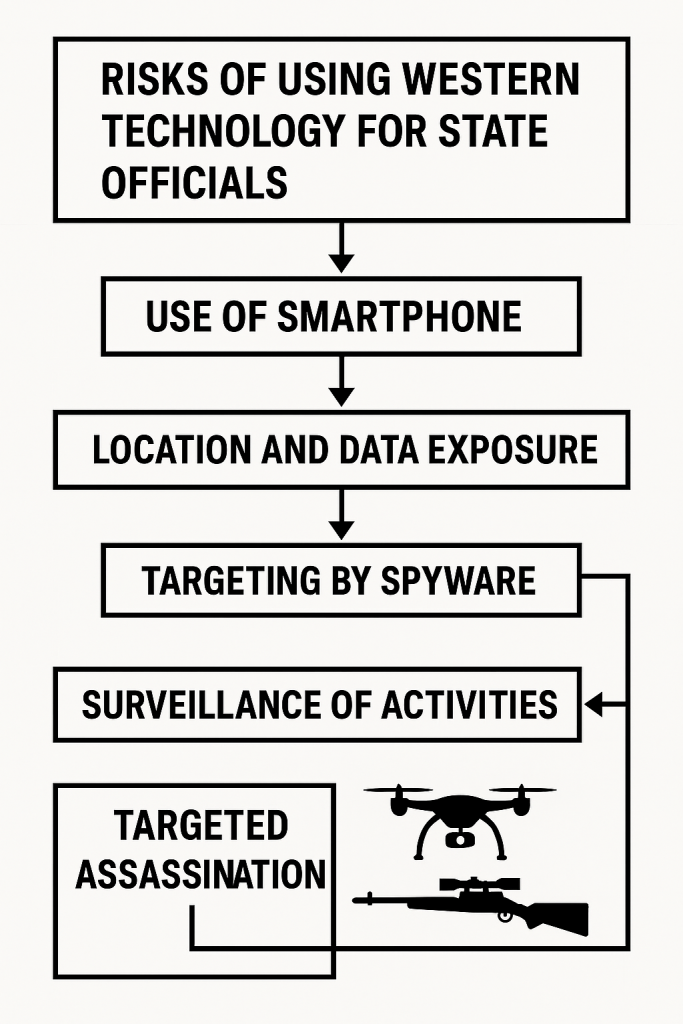
From the infamous exploding pagers in Lebanon to the recent assassination of a Hamas figure in Tehran, Western technology has repeatedly facilitated covert operations with deadly precision.
Many Iranian officials and scientists continue to rely on Western-made devices—smartphones, laptops, software—all of which are vulnerable to surveillance or sabotage. The assassination of an Iranian nuclear scientist right in his bedroom, traced in part to digital breadcrumbs, is a stark reminder of this vulnerability.
Russia and China have already begun prioritizing the development of domestic IT and telecommunications infrastructure to reduce dependence on potentially compromised systems. Iran must follow suit, particularly in securing sensitive communications and critical infrastructure.
The casual use of popular messaging apps, GPS tools, and cloud-based services by senior officials is no longer tenable. Like in Iran, many people in Russia (and apparently even top brass at least until 2023) still use to chat on Whatsapp, use GPS and Google tools. They should remember that their peers in Iran were killed by drones already waiting next to their homes, using the same principles as the drone systems in containers used to attack Russian bombers in Siberia. Believing that this only happens to others is far too risky today. The risk is no longer theoretical—it is proven and lethal.
Lesson 4: Preemptive Strikes and Targeted Killings Are Now Mainstream
Israel’s tactics in June 2025—particularly the wide-scale use of targeted assassinations—signal the normalization of methods long considered violations of international law.
While preemptive strikes are not new, their frequency and brazenness set a dangerous precedent. Other powers, including Russia and China, must now adapt not only by protecting their own officials and citizens, but by contemplating the strategic consequences of similar actions in defense or retaliation.
If such norms are now considered acceptable, no country can afford to remain passive.
To conclude this article, I shall just say a few words about the overall situation in the world after the end of the 12 days war.
Who Won the 12-Day War?
Both sides, predictably, claimed victory. But beneath the declarations, a few indicators stand out:
- Israel’s media blackout on damage to its military installations suggests significant losses.
- Economic and infrastructural damage in Israel appears severe.
- Israel was the first to propose a ceasefire, often an implicit sign of strategic strain.
Most importantly, a comparison of national capacities offers critical context:
- Iran’s landmass is 80 times larger than Israel’s; its population is roughly 10 times greater.
- Iran’s geography provides natural defense advantages, especially against a ground invasion.
- Israel, with limited strategic depth and only two industrial ports and one international airport, is more vulnerable.
Without U.S. support and its nuclear deterrent, Israel would be at a significant disadvantage in any prolonged conflict. The myth of the invincible and most ethical army is dead for good.
Nuclear Deterrence and the Israeli Paradox
One might ask: if Iran lacks nuclear weapons, why does Israel still fear an Iranian bomb?
The irony is that Iran’s current targeting limitations make a nuclear strike against Israeli cities like Jerusalem, Haifa, or Tel Aviv unlikely or morally unthinkable, as as it would create large amount of Palestinian victims. However, should Israel achieve its goal of depopulating Gaza and the West Bank of their native inhabitants, this calculus could change.
The fear, therefore, may be less about current capabilities and more about what the future could bring if strategic balances continue to shift.
Ukraine 2.0: The Broader Strategic Context
The parallels between the Ukraine war and the conflict in Israel are striking:
- Both are proxy theaters in a larger confrontation between the U.S.-led global order and the emerging Global South, led by China and Russia.
- Both Kiev and Tel Aviv have employed controversial tactics, including attacks on civilians.
- Both struggle with internal dissent and a population increasingly wary of endless conflict.
- And in both, Western involvement has served to prolong and escalate rather than resolve.
- Finally, both Kiev and Israel developed a high level of fanaticism, with hysterical public figures advocating ethnic cleansing and even genocide of the Russian speaking populations, respectively the Palestinians.
As NATO struggles to contain Russian advances in Ukraine, attention is shifting to Asia and the Middle East. The recent tensions between Russia and Azerbaijan reflect this reorientation. A new conflict in the Caucasus—possibly engineered to distract or destabilize—cannot be ruled out.
Yes, 2025 is everything but boring.
The post-12-Day War world is entering a new phase. Power dynamics are shifting. Strategic doctrines are evolving. And illusions—especially about diplomacy, deterrence, and technology—are being shattered.
Postscript: Little-Known Realities About Iran and Israel
A few factual observations, based on firsthand experience and often overlooked in Western narratives:
- Iran boasts a highly educated population, with a strong culture in engineering and science, comparable to Japan or Russia. Women are prominently represented in academia and business.
- Iran’s fertility rate (1.9) matches that of France and is lower than many regional peers. In contrast, Israel’s rate (2.9) is driven largely by ultra-Orthodox Jewish families.
- Despite Western portrayals, Iran is not a theocratic dictatorship akin to Afghanistan. It has a functioning political discourse and a complex, adaptive society.
- Jews in Iran—about 10,000 today—live in relative peace and enjoy representation in parliament.
- Iranian political culture is rooted in debate and pragmatism. Extremist rhetoric is largely absent from official discourse.
Finally, Iran is the modern successor of ancient Persia, a civilization that once encompassed much of the Middle East. Perhaps one day, the grandchildren of Persepolis may indeed be inspired by zionism and return to the lands they once ruled—not by force like in Palestine, but through historical continuity.