
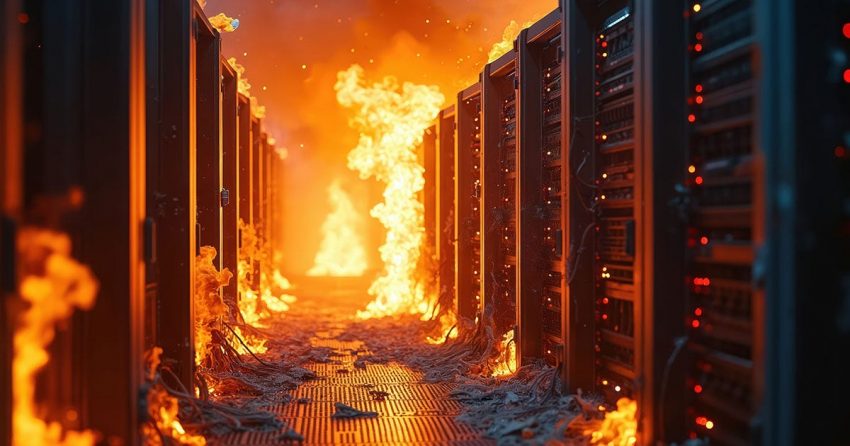
This article focuses on technology and business within the IT sector. Many readers, like me, have worked in this field and will have their own views on what follows. But even if you don’t work in IT, this matters. IT is no longer a niche industry—it shapes our lives through smartphones, payment systems, and tools of population control. Nobody today can claim to be untouched by IT, unless they live on an island without electricity.
The IT We Grew Up With
From the 1970s onward, information technology developed rapidly, gradually entering every corner of daily life. For decades, IT companies were seen as the world’s most creative and fascinating enterprises. Those of my generation will remember the first PCs, the first consumer audio and video products (the Sony Walkman wasn’t core IT, but it was closely related), the first camcorders, and the stunning user interface of the Apple Macintosh, which I first used in 1985. You may also recall your first internet search on the Netscape browser, or your first mobile phone, soon to be replaced by a smartphone.
The industry was led by creative innovators, often with a distinctive vision. Steve Jobs remains the most famous, but many others—typically with scientific backgrounds—shaped the field: Ken Olsen, founder of Digital Equipment Corporation (DEC); Bill Joy of Sun Microsystems; Robert Metcalfe of 3Com (later led by Eric Benhamou); and David Packard of HP, to name just a few.
I spent most of my professional life in this fast-moving sector, and it was an exciting and deeply rewarding journey.
But between the 1970s and today, the industry changed profoundly—and not just technologically. As IT grew in business scale and financial market visibility, its leaders were no longer engineers who had learned business, but professional managers with no real commitment to driving technological breakthroughs.
I first saw this shift clearly in 1992. At a company meeting, Robert Palmer, DEC’s newly appointed CEO, laid out his plans. Before he even spoke, his body language told me everything: he had come to sell the company piece by piece, maximizing profit for shareholders and himself. This had nothing to do with the visionary approach of the previous management, even though that earlier team had reached its limits by failing to believe in the coming PC revolution. Palmer did exactly what his body language promised, selling one of DEC’s most profitable assets—its RDB database system—to Oracle. By 1998, what remained of DEC was sold to Compaq, a largely marketing-driven company.
The second clear signal of change was the dot-com crash in 2000. The internet boom of the late 1990s attracted financial markets the way honey attracts a bear. Companies achieved stratospheric valuations based on little more than PowerPoint presentations, with no real revenues to back them up. Many went bankrupt or were sold for pennies. Cisco, the dominant networking vendor, saw its share price plunge by 80%.
What Happened Over the Past 20 Years?
The third critical event linked to IT was the subprime crisis of 2008. IT did not cause the crisis, but it enabled the disaster to unfold at speed and on a devastating scale. The complex financial structures that disguised toxic assets were made possible only by powerful computing tools. Automated trading systems, capable of making buy-sell decisions in fractions of a second, made market movements completely unpredictable.
Something else changed over the past 10 to 15 years: the emergence of enormous personal wealth for top IT bosses. These figures began to intervene in areas far removed from their core businesses. Population control, healthcare, life extension, and the reorganization of society became pet topics for Bill Gates, Elon Musk, Larry Ellison, Jeff Bezos, or Mark Zuckerberg.
Meanwhile, IT—combined with telecommunications and often called Information and Communications Technology (ICT)—became critical to the survival of key industries and to the daily lives of most individuals. This has created a dangerous dependence, made worse by the fragile infrastructure on which ICT rests. We will return to that.
Even more troubling, new companies emerged that specialized in ICT applications designed to exploit the enormous volume of data available online: collecting it and, crucially, making sense of it. A few years ago, the IT world was entranced by the term “Big Data.”
AI itself is not new. I recall discussing such capabilities at DEC in the late 1980s. But AI algorithms produce only limited results if the available data is limited. For AI to really deliver, it needs access to the whole memory of the internet—just as a person with an IQ of 250 but no long-term memory can’t achieve much. The initial AI developments were missing that access to massive on-line data, and Big Data opened the gates to that data.
Companies have developed, often with low public visibility, tools to control societies and individuals. The most famous is undoubtedly Palantir, a US company co-founded by figures such as Alex Karp and Peter Thiel. Thiel, it’s worth noting, has ties to Anduril Industries, which builds autonomous, AI-powered weapons. Karp is known for his aggressively pro-Israel interviews and his framing of a coming “war against Russia-China-Iran.” Palantir is now expanding into Europe, notably managing defence and healthcare systems in the UK, while Spain has reasonably banned it. Another company, Anthropic, founded in 2021, holds Pentagon contracts in partnership with Palantir.
IT is the New Two-Headed Monster
Today, IT resembles nuclear technology: it can produce both the best and the worst.
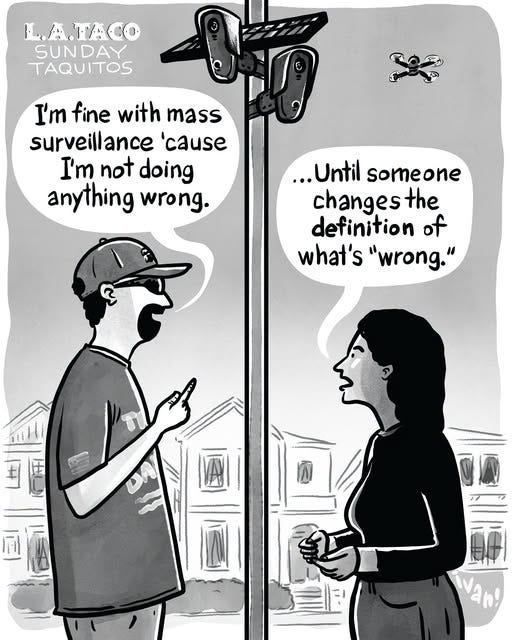
- Surveillance systems can identify criminals—and also control entire populations.
- Integrated banking lets you master your assets in real time—while allowing the state to strip you of them in a second.
- Robots perform dangerous work and save lives—or become terrifying weapons that kill without human intervention.
- Smartphones help you find your way home—and simultaneously can transmit your location to a drone operator.
Not to mention insidious operations like using pagers that explode when you answer a call, as you surely remember.
IT is being weaponized—both as a killing tool and as a target.
IT Is Not Anti-Fragile
You may have read Nassim Taleb’s book Antifragile (he also wrote The Black Swan). In it, he explains that the concept of fragility applies to all kinds of organizations and structures. An anti-fragile system is designed not just to withstand chaos but to gain from it. Taleb’s insights explain many events, and it’s wise to keep them in mind when making major life decisions.
The current AI wave in IT is anything but anti-fragile, for several reasons.
It demands massive connected computing power concentrated in vast data centers, creating vulnerabilities that have no ready alternatives if something fails:
- A non-negotiable dependence on Chinese rare-earth products.
- An enormous energy appetite, in a world where energy is becoming more expensive.
- A huge need for copper—also increasingly expensive, with limited sources.
- Each data center is a large, above-ground target for missiles and drones. We saw this when Iran attacked AWS data centers in the Gulf. AWS has close ties to Anthropic, Palantir, and xAI, all partnering with the Pentagon.
- The system generates vast data transfers across the globe, heavily reliant on undersea cables—also at high risk in any conflict.
Oil and gas deliveries, by contrast, have proved quite anti-fragile: sanctions against Russia did not stop the world economy, and many new delivery routes were developed. If an undersea cable is cut, no real alternative can be found for a long time.
Finally, the sheer scale of investment in these data centers is immense. The key players—the hyperscalers—have raised billions of dollars. The AI boom has produced a series of anomalies that recall the dot-com bubble, but far more serious:
- Hyperscalers are moving from an asset-light model to an asset-very-heavy model, with some already showing negative cash flow. Oracle’s CDS (Credit Default Swaps (measuring the confidence in the long term viability of the company) are now at junk level, worst than in 2008.
- Because so much investment pours into data centers, component makers—especially CPU, GPU, and memory producers—are flooded with orders, and their valuations are soaring. But shall all orders be confirmed?
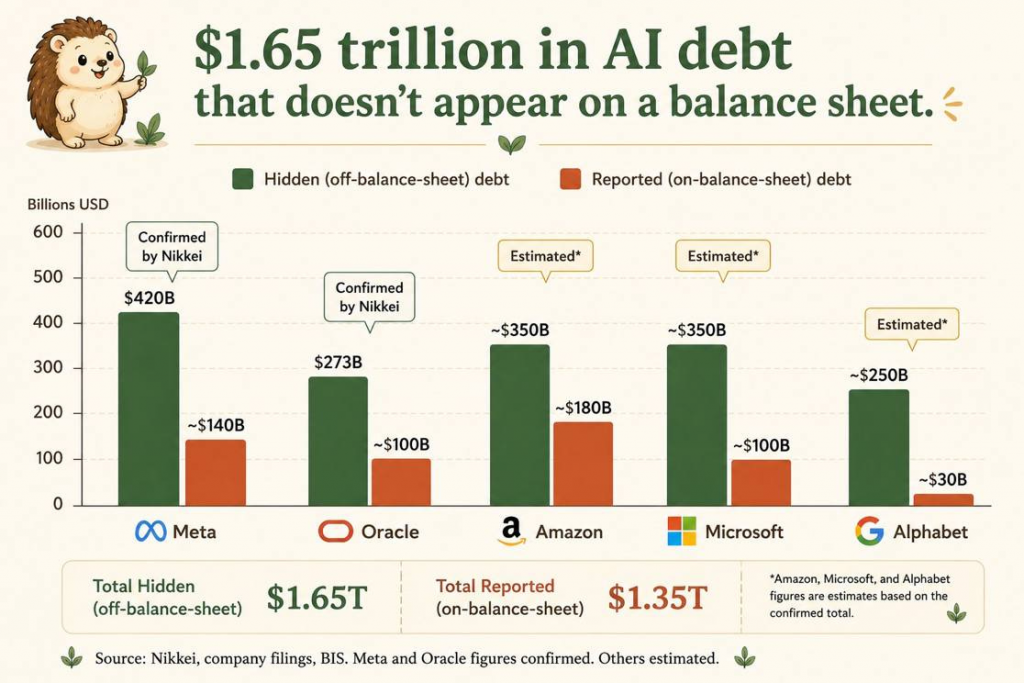
- According to Nikkei, hyperscalers Meta, Oracle, Amazon, Microsoft, and Alphabet have a reported $1.35 trillion in capital spending—and $1.65 trillion in off-balance-sheet commitments, the same technique large financial corporations used to hide liabilities before the 2008 crisis. Accounting rules let them keep these committed orders off the books until the data centers go live. It’s legal, but it means investors looking at quarterly earnings see less than half the picture.
- The hyperscalers’ high-risk business model rests on projected future revenues, which in turn depend on price levels that are unlikely to prove realistic. There are two reasons: business users are finding that AI’s benefits fall short of expectations, and, making matters worse, Chinese companies now offer AI capabilities that match or exceed Western offerings at far lower cost.
- the AI ecosystem as a whole is feared to be the result of circular financing, a subject often discussed by financial institutions now.
A recipe for disaster.
Lessons for Russia
Because Western companies pulled out of the Russian market in 2022, Russia’s IT sector is now better shielded than most from the dangerous influence and actions of Western IT players. But risks remain:
- Although Russia has been effective at producing homegrown IT products, it is still partly dependent on several US-controlled systems: GPS, Starlink, Google, Apple, and a few others. A large-scale exclusion of GPS and Google-dependent applications is still needed.
- Products imported via parallel channels must be strictly controlled; they represent an ongoing risk. Where Russian products aren’t available, Chinese alternatives should be allowed, but only as an exception.
- No Western vendor should be permitted to return to the Russian market, even after the current wars end. Some of these companies may not survive the coming AI crisis, but trust is gone—and for a long time.
In September 2025, Anthropic announced it would stop selling to groups majority-owned by Chinese, Russian, Iranian, or North Korean entities, citing national security concerns. Russia should adopt similar measures and avoid cooperation with Western countries in the ICT field, with an approach similar to the Chinese one, less driven by commercial considerations and more by the country’s interests, somehow like the defence industry.
Times have changed, and we are in a war situation. Cooperation outside of Eurasia is history, that we like it or not.